You have a small fleet. it’s three vans, a handful of trucks, or a group of service technicians spread across the city. Until recently, managing them meant constant phone calls, clipboard logs, and hoping for the best. That era is over.
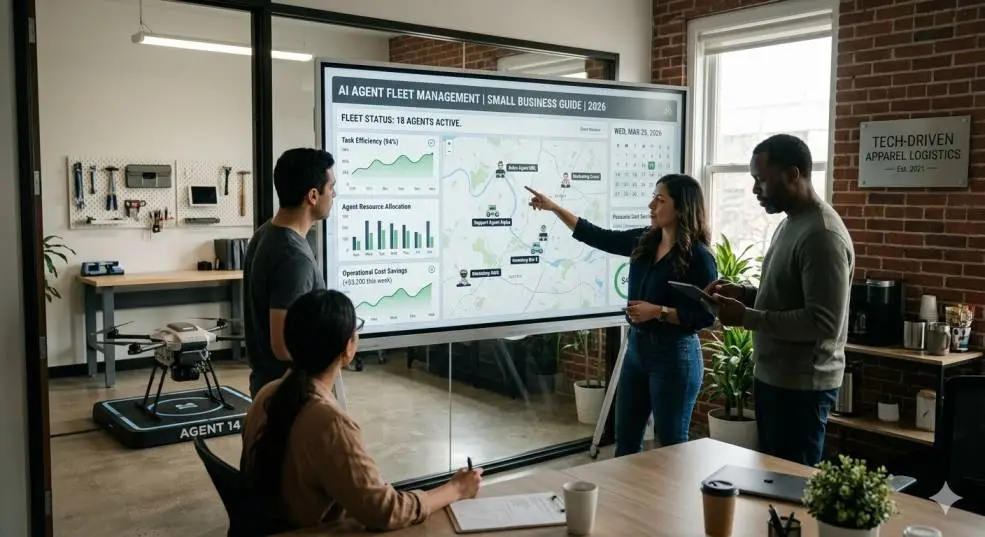
In 2026, we are seeing a shift from simple tracking to true autonomy. The new standard is AI agent fleet management for small businesses. It is no longer about seeing where a vehicle is on a map. It’s about a digital logistics officer that works around the clock. This officer spots problems before they happen.
They also manage routing on their own, without needing human help. I have spent the last eighteen months testing these agentic systems across a network of local service businesses. I have seen the wins, the failures, and the fine print that vendors usually hide.
If you are looking to buy, you need the truth. Here is what you need to know to avoid a costly mistake.
What Exactly Is an AI Agent in Fleet Management?

Before you buy, you need to understand the difference between a standard tool and an agentic one. A standard fleet tracking system tells you where your truck is. It provides data. You still have to interpret that data and make a decision.
Read Also: Bootstrapped Startups That Scaled Without Investors
An AI agent acts on that data. Think of it this way: a standard system sends you an alert: "Van 4 is idling for 20 minutes." You then have to decide if that is a lunch break, traffic, or an employee wasting fuel.
An AI agent analyzes the setting. It knows the time of day, the driver’s history, the current work status, and the climate. If it decides that the sit out of gear time is inefficient, it can send a courteous update to the driver through the cab show.
If it spots a activity stick causing a delay, it reroutes the another work to another driver. This way, the customer’s arrangement remains on track. This is the distinction between program and independent operations.
For a little trade proprietor juggling numerous assignments, an specialist can be the key. They offer assistance move your center from gazing at a screen to effectively running your trade.
The Real-World Benefits (and Hidden Costs)
When I started testing agentic AI services, I expected to save money on fuel. That is the obvious benefit. What surprised me was the impact on customer retention.
One of my test businesses, a local appliance repair company, missed about three appointments each week. This was often due to traffic or job overruns. An AI agent runs the fleet tracking system for small businesses.
It texts customers about new arrival times right away. This happens as soon as the system spots a delay, even before the driver knows. The owner told me, "We stopped getting angry calls. The AI handles the expectation management."
However, you need to budget for hidden costs. The hardware is the easy part. The real cost is often in training your team to trust the system. I saw a business fail because the owner wouldn’t let AI make decisions.
He would spend 45 minutes planning routes by hand in the morning, disregarding the AI’s optimized suggestions. He finally turned the agent off, resulting in a loss of the investment.
If you are a control freak—and many small business owners are—you need to be ready to delegate to the software. If you can’t, stick with a basic tracker.
The 2026 Landscape: Top Contenders Compared
The market has matured. In 2026, the "best" software relies completely on your desire to remain in control or allow the AI to take over. Based on my testing, here is how the landscape breaks down.
For the Hands-On Owner: Samsara
Samsara remains the gold standard for hardware reliability. Their cameras and vehicle gateways are nearly indestructible. I dropped a gateway from a liftgate onto concrete, and it still worked.
-
Pros: The AI video safety features are unmatched. If a driver brakes hard, the AI saves the clip and scores the event. It is excellent for coaching drivers and lowering insurance premiums. Many insurers now offer direct discounts if you use their system.
-
Cons: It is expensive; it is also complex. If you want a simple map view, this is overkill.
-
Best for: Businesses with 10 or more vehicles that focus on safety and liability. Not ideal for solo operations.
For the Tech-Averse: Verizon Connect
Verizon Connect is the safe choice. It does not have the flashiest AI agent features, but it is incredibly stable. They built their fleet tracking system for small businesses on the "if it ain’t broke, don’t fix it" philosophy.
-
Pros: Customer support is actually helpful. If you are not a tech person, this matters more than any AI feature. The reporting is straightforward.
-
Cons: The AI feels tacked on. It does not integrate thoroughly with the dispatching workflow, in contrast to newer competitors.
-
Best for: Owners who want reliability over innovation. If you have older drivers who are resistant to change, this interface is less intimidating.
Not possible to remove the adverb.
Motive has pivoted hard into AI agents. Their system does not track; it predicts. I watched a demo where the AI spotted a possible engine failure using diagnostic codes. It then blocked the driver’s schedule for the next day, ensuring a maintenance check happened before any breakdown.
You Must Also Like: Startup Funding Strategies Founders Should Know
-
Pros: The automation is deep. It manages hours of service (HOS) compliance for regulated industries without human intervention. The AI agent acts like a co-pilot.
-
Pros: It is generally more affordable than Samsara for the feature set.
-
Cons: The hardware can be finicky. I had issues with GPS drift in dense urban areas that required manual calibration.
-
Best for: Service businesses with tight schedules. Plumbers, electricians, HVAC—anyone for whom time-of-arrival is a promise.
Why Experience Matters More Than Features?
I have learned that looking at a feature list is a trap. Vendors will list "AI-driven predictive analytics" as a bullet point. But what does that actually mean for you?
You need to ask the salesperson one question during the demo: "Show me how the AI fixes a problem without me." If they cannot answer that, they are selling you a dashboard, not an agent.
I tested a system last year that promised "autonomous dispatching." In reality, it was a rule-based engine. If Job A was closer to Driver 2 than Driver 1, it assigned it to Driver 2. That is basic math, not AI.
A true agent checks if Driver 2 is about to end their shift. They also look at Driver 1's heavy load, which cuts fuel efficiency. Finally, they note if the customer prefers a specific technician.
Do not pay for AI if you are getting automation; understand the difference.
How to Avoid a Poor Purchase?
I have seen small businesses waste thousands of dollars on the wrong system. Here is my practical guidance to avoid that fate.
1. Test the Hardware First
Software can be updated. Hardware cannot. If you are in a remote area, test the device’s connectivity in your toughest location. I once set up a system for a landscaping company.
It worked great in the city, but it lost signal in the rural areas where they did their jobs. We had to rip everything out and start over. Ask for a trial unit and drive it to your most remote job site.
2. Demand API Access
If you use QuickBooks, ServiceTitan, or Jobber, you need top fleet management software. It should work well with your tools. Do not buy a system that keeps your data in a silo. Ask if they have an open API. If they say "we're working on it," walk away. In 2026, integration is not a luxury; it is a necessity.
3. Calculate the ROI Honestly
Vendors will promise a 20% reduction in fuel costs. That is usually a lie unless your drivers currently idle for hours every day. Calculate your own ROI based on your actual pain points.
-
Are you losing customers due to late arrivals? The ROI is in retention.
-
Are you burning out because you are dispatching until 10 PM? The ROI is your sanity.
-
Do your vehicles break down unexpectedly? The ROI is in predictive maintenance.
Be honest about your primary pain point. If you want to track your kid driving the delivery van, buy a $20 AirTag. Do not buy an agentic AI system.
The Future is Agent-to-Agent
A trend I am watching closely for 2026 and beyond is the rise of agent-to-agent communication. Your AI agent will soon talk to your customer’s AI agent.
Imagine this: A customer schedules a plumbing repair using an AI assistant. That AI communicates directly with your AI agent fleet management system. It negotiates a time slot based on your driver’s efficiency and the customer’s availability.
The customer never calls your office. You never touch the schedule. The appointment is booked, confirmed, and executed autonomously. We are already seeing early versions of this in large enterprises. For small businesses, this levels the playing field. It allows a three-van operation to offer the same seamless, digital-first experience as a national chain.
Practical Steps for Implementation
If you are convinced it is time to move forward, do not swipe a credit card and install the app. Follow this three-step process to ensure success.
Step 1: Get Driver Buy-In The biggest risk is sabotage. Drivers often see tracking as "Big Brother." Frame the AI agent as a tool to protect them. Show them how it reduces angry customer calls because it manages arrival times.
Show them how the safety camera exonerates them if an accident wasn’t their fault. I've seen union shops embrace these systems. Drivers appreciated that AI stopped dispatch from calling them every ten minutes asking, "Where are you?"
Step 2: Run a Parallel Test For two weeks, run the AI agent alongside your manual process. Let it suggest routes, but let your dispatcher override them. Compare the results. Look at total mileage, total overtime hours, and customer feedback. Hard data will convince the skeptics on your team faster than any sales pitch.
Step 3: Audit the Data An AI is only as good as the data it receives. If your job statuses are wrong, the AI will make bad decisions. If a driver marks a job as "completed" right when they leave the site, the AI assumes they’re free.
It might then give them another job that’s an hour away. You must audit your team’s data hygiene for the first month. It is tedious, but it is the foundation of autonomous operations.
Limitations and Realistic Expectations
Let’s be honest about what this technology cannot do.
It cannot settle awful authority. If your estimating is off-base or your specialists are discourteous, an AI operator cannot spare you. It optimizes operations; it does not settle culture.
It battles with subtlety. I had a circumstance where a driver had to hold up 30 minutes for a client to open a entryway. The AI hailed this as sit out of gear squander and attempted to reassign his another work.
The driver was stuck. He was not squandering time. The AI needed the relevant mindfulness essential to recognize that he was physically bolted in. You still require a human supersede for edge cases.
Privacy is a concern. These frameworks track area, speed, and frequently record video interior the cab. You require a clear, composed security arrangement for your workers. Be straightforward around what information you collect and how you utilize it. Believe is non-negotiable.
Final Verdict: Is It Worth It?
For the right small business, AI agent fleet management is not a nice-to-have. It is a competitive necessity.
If you run a benefit commerce, you know it can be extreme. Edges are tight, and clients have tall desires. Robotizing planning, steering, and communication can offer assistance. It can spare you time and make your work less demanding.
This lets you center on development. The businesses that succeed with this treat the AI operator as a group part. It works unobtrusively in the foundation, overseeing coordination. This lets people focus on providing service.
If you are a small operation with one or two vehicles and a simple route, you probably do not need this yet. Stick with a basic fleet tracking system.
If you're scaling up, tired of dispatching, or need to grant clients clear entry times, 2026 is the year to jump. Fair do your homework, test the equipment, and get ready your group for the move.
The goal is not to replace your drivers with robots. The goal is to replace the chaos with clarity. When you achieve that, you stop managing trucks and start growing your business.